Most warmer drawer evaluations begin with the wrong question. People open the drawer, feel warmth inside, and assume the appliance is functioning correctly. From a repair perspective, that test reveals almost nothing about actual performance. A warmer drawer can produce heat every day and still fail at its primary job. The purpose of a warmer drawer is not to keep food warm. Its purpose is to slow down the rate at which food quality changes after cooking.
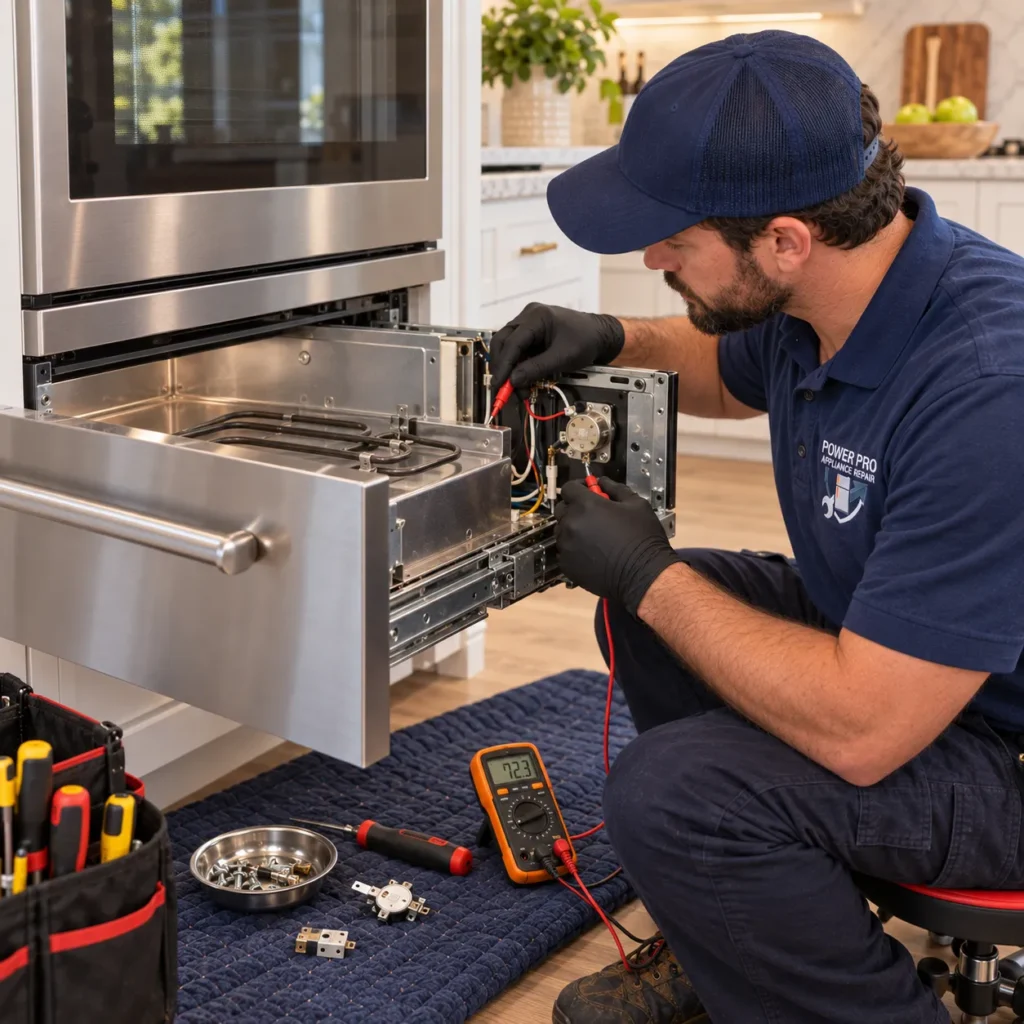
One pattern that appears repeatedly in service situations is what can be described as the food-holding window. Every warmer drawer has a period during which food maintains acceptable quality after cooking. During this period, texture remains stable, moisture loss remains controlled, and serving conditions stay predictable.
When performance begins to decline, this window starts shrinking. A meal that previously held quality for ninety minutes may now begin changing after forty-five. Bread may become firm sooner than expected. Proteins may tighten more quickly. Fried foods may lose their intended texture in less time.
Most owners interpret these changes as food-related issues. In reality, they often indicate that the holding environment inside the drawer is no longer behaving the same way it once did. The drawer still creates heat. The food holding window becomes shorter. This is often the earliest sign of performance degradation.
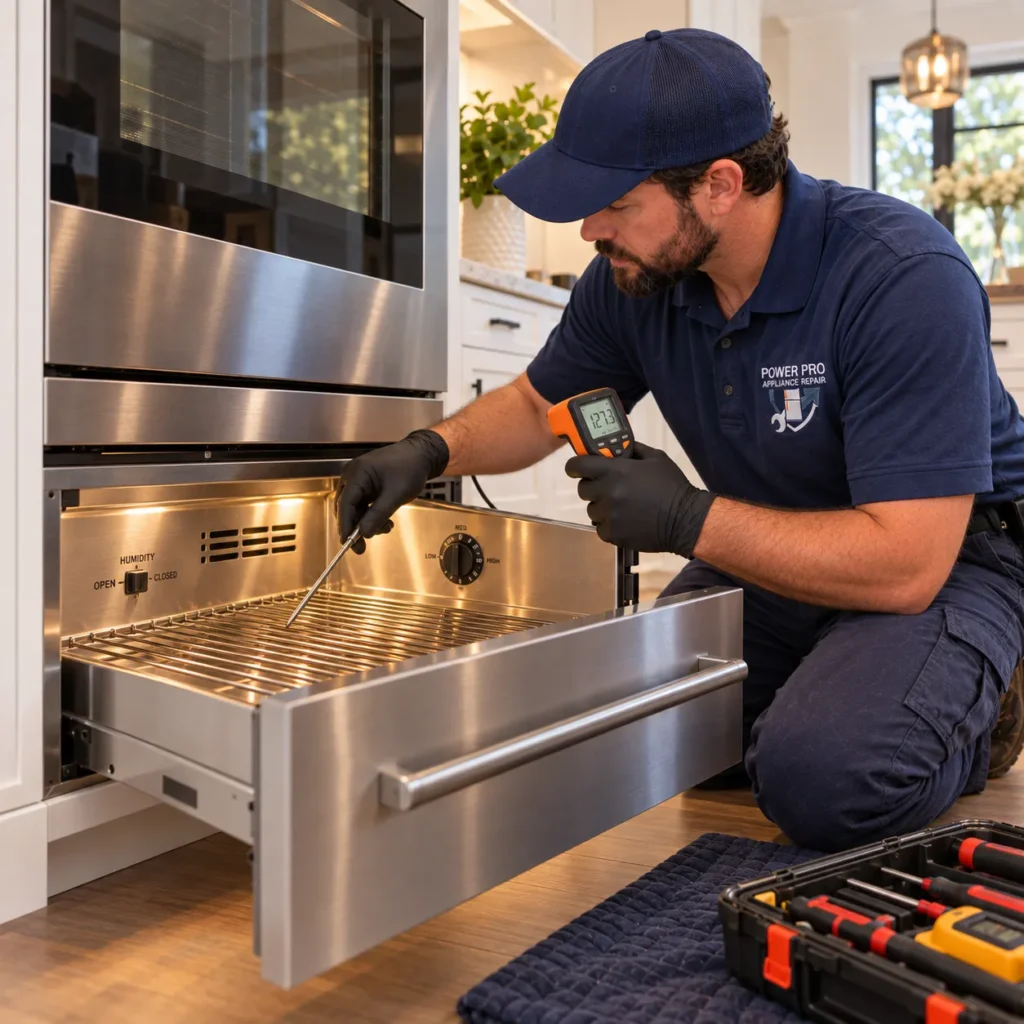
At Power Pro Appliance Repair, warmer drawer evaluation focuses on food behavior patterns rather than component assumptions. The first step is identifying whether the holding window has changed.
The second step is determining whether food quality loss is occurring through moisture loss, texture shift, or environmental inconsistency.
The third step is identifying what changed inside the holding environment to create that behavior. This process allows repairs to focus on restoring the conditions that support long-term food stability rather than focusing solely on heat production.
The objective is to return the drawer to its original role as a controlled holding environment where food quality remains predictable throughout service periods.
Every repair backed by our parts & labor guarantee.
Fast scheduling, often fixed the very same day.
Factory-trained pros for all major brands.
Honest quotes with no hidden fees, ever.
A common assumption is that holding performance depends mainly on temperature level. Actual food behavior suggests otherwise.
Two warmer drawers operating at similar temperatures can produce completely different results. One preserves food conditions for extended periods.
The other accelerates moisture loss and texture change despite reaching the same temperature target.
The reason is that food responds to environmental stability, not temperature alone. Small fluctuations repeated over long holding periods influence food quality more than most users realize.
A drawer that repeatedly gains and loses heat creates a different holding environment than a drawer that maintains controlled stability.
From a diagnostic standpoint, understanding heat behavior over time provides more useful information than measuring temperature at a single moment.
Most warmer drawer issues fall into one of three performance categories. The first is moisture management failure. Food remains warm, yet internal moisture disappears faster than expected. Bread products often reveal this problem early because texture changes become noticeable before temperature changes. The second is texture preservation failure.
Temperature remains acceptable, but food structure changes during holding. Proteins become less tender, baked items lose consistency, and prepared dishes behave differently despite appearing adequately warmed.
The third is environmental consistency failure. Food placed in different sections of the drawer experiences different holding conditions. One area performs normally while another produces accelerated quality loss.
This indicates that the internal environment is no longer behaving uniformly. Separating complaints into these categories creates a much clearer diagnostic direction than treating every issue as a heating problem.
Different foods expose different weaknesses inside the holding environment. This is why service evaluation often begins by discussing what types of food are affected first. Bread products are often early indicators of moisture instability. They react quickly when environmental conditions become too dry. Protein-based foods frequently expose temperature consistency problems. Small fluctuations become visible through texture changes during extended holding periods. Covered dishes and uncovered dishes can reveal another layer of information. If performance differs significantly between the two, the issue often involves environmental stability inside the chamber rather than heat generation itself. These observations help identify where the holding environment is changing long before complete failure occurs.
One of the most overlooked aspects of warmer drawer performance is that temperature readings alone rarely tell the full story. A drawer can achieve the correct temperature and still create poor holding conditions. The reason is that food responds to the entire environment surrounding it. Moisture movement, thermal consistency, recovery behavior after opening, and chamber stability all influence results. This explains why some units pass basic temperature checks yet continue generating complaints from owners. The issue is not reaching the temperature. The issue is maintaining the conditions that preserve food quality throughout the holding cycle.
Warmth and holding performance are different measurements. Many drawers continue producing heat after the environmental conditions required for food preservation begin changing.
The food holding window is the period during which food maintains acceptable texture, moisture, and serving quality after cooking. Performance issues often appear as this window becomes shorter.
Bread reacts quickly to moisture instability. Changes in environmental conditions often become visible in bread before they appear in heavier foods.
Yes. Many performance issues involve environmental stability rather than total heating failure. The appliance may still generate heat while producing poor holding results.
In many cases, the earliest sign is reduced holding quality over time rather than loss of temperature. Food begins changing faster than it did previously under the same conditions.