When homeowners call about an ice machine, the concern is usually simple: there is less ice than there used to be. From a service standpoint, that observation is only the final result of a process that began much earlier. An ice machine can continue producing ice while gradually losing efficiency from one production cycle to the next. The storage bin reflects the outcome, not the source of the problem. Water supply, freeze duration, evaporator performance, harvest timing, and bin sensing all influence how consistently the machine keeps up with daily demand. A small disruption in one stage may reduce production long before the appliance stops making ice altogether.
Across homes and businesses in Algonquin, we frequently see ice machines that still appear operational but struggle to refill the bin during busy periods or after continuous use. At Power Pro Appliance Repair, every ice machine repair in Algonquin, IL begins by identifying where production consistency changes instead of focusing only on the visible symptom. Understanding how the production cycle has shifted allows repairs to address the underlying condition rather than the temporary result.
Many service calls begin with the same concern. The machine is producing less ice than before, taking longer to refill the bin, creating irregular cubes, or stopping production for periods throughout the day.
What makes ice machines different from many household appliances is that reduced output does not always point toward a cooling failure. A machine can maintain low temperatures and still struggle to keep up with demand.
In field diagnostics, it is common to find production issues connected to conditions that develop long before the freezing stage becomes a problem. Water delivery is one example. A slight reduction in incoming water volume can change cube formation across multiple production cycles.
Every repair backed by our parts & labor guarantee.
Fast scheduling, often fixed the very same day.
Factory-trained pros for all major brands.
Honest quotes with no hidden fees, ever.
Ice machine problems are often diagnosed from the symptom instead of the condition creating the symptom. A unit producing fewer cubes may receive a refrigeration diagnosis simply because ice volume has dropped.
Another may have components replaced after production slows, only for the same issue to return weeks later.
In many cases, the original cause was never identified because the machine was evaluated from the result rather than the production process itself.
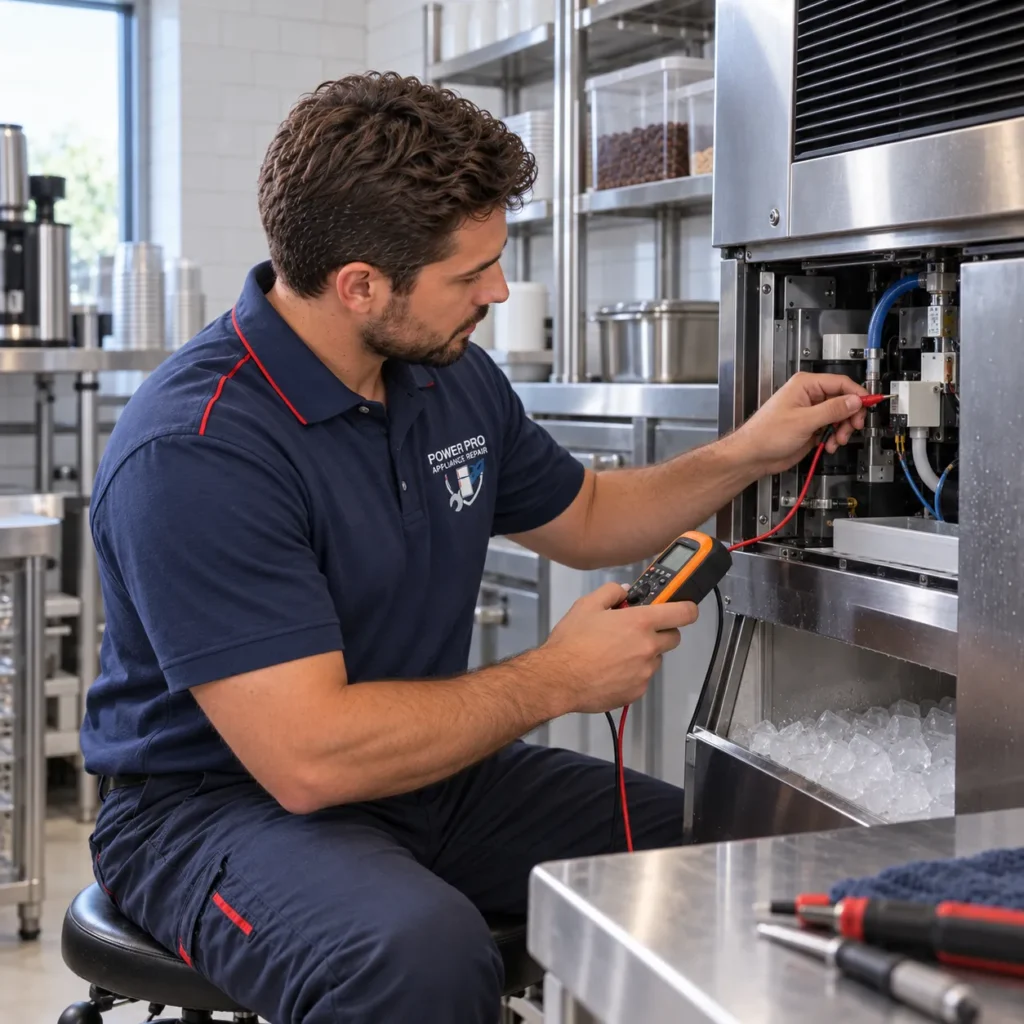
At Power Pro Appliance Repair, the repair approach follows the machine’s operating sequence. Production cycles are evaluated from water entry through freeze formation and harvest completion. This allows us to identify where efficiency is being lost instead of assuming the issue based on output alone.
Many homeowners assume that if an ice machine can still make ice, the system is functioning normally. The reality is more complicated. Ice capacity and ice production are not the same thing.
Capacity refers to how much ice the machine can store. Production refers to how efficiently it creates new batches over time.
A machine may still fill part of the storage bin while producing significantly less ice than it was designed to. This happens when production cycles begin taking longer to complete or when each cycle produces less ice than expected.
One of the more common examples involves machines that appear operational throughout the day but never maintain a full bin. The issue is not always a lack of cooling.
In some cases, the machine is losing efficiency during cycle transitions, creating a small reduction in output that compounds across dozens of production cycles.
Understanding this difference helps explain why many ice machine problems develop gradually rather than appearing overnight.

Ice production depends on multiple stages working together. Reduced output can result from water supply issues, harvest-cycle interruptions, sensor inaccuracies, or production timing changes, even when the machine continues operating.
Smaller cubes often indicate that the machine is receiving less water than intended or that production cycles are ending before full cube formation is reached.
Yes. Many production issues develop gradually. The machine may continue creating ice while producing fewer batches per day than normal.
Long refill times often indicate a loss of production efficiency somewhere in the cycle. Water delivery, freeze duration, harvest performance, and sensing functions can all affect daily output.
Irregular cubes can develop when water distribution changes, freeze conditions become inconsistent, or cycle timing no longer matches the machine’s intended production process.